VAT declaration helper
Prepare what your supplier will need, then print it or copy it onto the supplier's own form. It does not decide whether you qualify; the supplier does that with your declaration.
It works in your browser: nothing you type here is sent to us or saved, and it never travels with a quote enquiry. Wording checked 13 Nov 2026 against GOV.UK, HMRC's VAT Notice 701/7 and HMRC's declaration form page.
No VAT for a disabled buyer: what the declaration does
GOV.UK's guide says that if you are disabled or have a long-term illness, you are not charged VAT on products designed or adapted for your own personal or domestic use, or on the installation and any extra work, repairs or maintenance, spare parts or accessories. Certain types of stair lift are among its examples. Source: VAT relief for disabled people (GOV.UK guide) (checked 13 Nov 2026)
For VAT purposes GOV.UK treats you as disabled or long-term ill if you have a physical or mental impairment that affects your ability to carry out everyday activities, you have a condition that is treated as chronic sickness, like diabetes, or you are terminally ill. It adds plainly that you do not qualify if you are elderly but not disabled, or only temporarily disabled. Source: VAT relief for disabled people (GOV.UK guide) (checked 13 Nov 2026)
How it works in practice is set out in HMRC's notice to suppliers:
- There is no certificate. HMRC does not supply an exemption certificate. The supplier should get a written declaration from each customer, holding enough information to show they meet the conditions. HMRC cannot say whether a person is chronically sick or disabled. Source: Reliefs from VAT for disabled and older people, VAT Notice 701/7 (HMRC) (checked 13 Nov 2026)
- It is separate from the order. The declaration should be separate from, or clearly distinguishable from, any order form or invoice; signing an order should not automatically mean signing a declaration. Source: Reliefs from VAT for disabled and older people, VAT Notice 701/7 (HMRC) (checked 13 Nov 2026)
- Someone else can sign. Where the person cannot sign, for example a child or someone who cannot write, a parent, guardian, doctor or another responsible person can. Source: Reliefs from VAT for disabled and older people, VAT Notice 701/7 (HMRC) (checked 13 Nov 2026)
- Electronic is fine. Suppliers can accept declarations by email or online. Source: Reliefs from VAT for disabled and older people, VAT Notice 701/7 (HMRC) (checked 13 Nov 2026)
- The supplier keeps it. HMRC's own template says the supplier keeps the declaration with its records and does not return it to the customer or send it to HMRC. Source: Declaration of eligibility for VAT relief, disabled person (HMRC form) (checked 13 Nov 2026)
Two cautions matter for stair lifts. First, the product has to qualify as well as the person: HMRC's notice words the stair lift item as one designed for use in connection with a wheelchair, and treats installing a lift between floors of a disabled person's home separately, so ask the supplier how it applies the relief to the lift you are buying. Second, a declaration is a statement, not proof: the supplier can ask for further evidence, and HMRC warns of penalties for knowingly accepting false declarations and for fraudulent evasion of VAT. Source: Reliefs from VAT for disabled and older people, VAT Notice 701/7 (HMRC) (checked 13 Nov 2026)
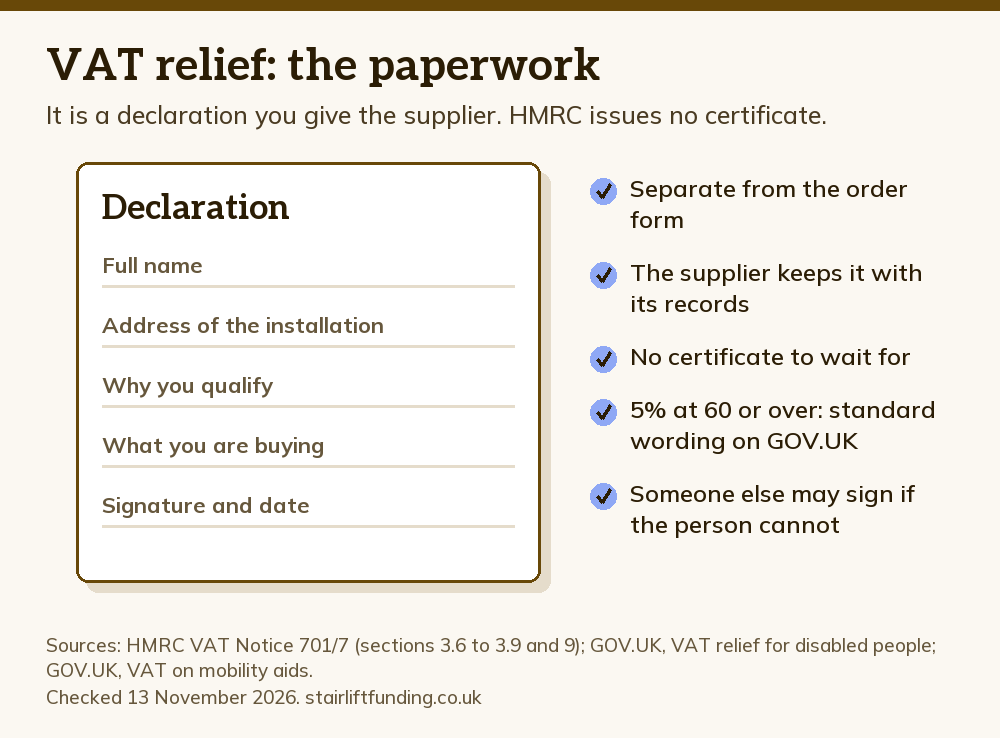
5% VAT at 60 or over: the standard wording
If the person is aged 60 or over and not disabled, GOV.UK says they pay a reduced rate of 5% on certain mobility aids, stair lifts included, when they pay for them to be supplied and installed in their home. A friend, local council, charity or housing association can order and pay for it on their behalf. Source: VAT on mobility aids for people aged 60 or over (GOV.UK guide) (checked 13 Nov 2026)
GOV.UK gives the wording to sign and date:
I [full name] of [the address where the installation is taking place] declare that I am aged 60 or over and that this supply and installation qualifies for the reduced rate of VAT in accordance with The Value Added Tax (Reduced Rate) Order 2007.
The helper above fills in the name and address for you. Three conditions decide whether it applies:
| Condition | What GOV.UK and HMRC say |
|---|---|
| Age | 60 or over when the product is supplied and installed |
| Installation | It must be installed: buying it alone does not get the reduced rate, and the supplier must install it |
| Where | A private home, including one shared with friends or relatives; a residential care home does not qualify |
Sources: VAT on mobility aids for people aged 60 or over (GOV.UK guide) (checked 13 Nov 2026); Reliefs from VAT for disabled and older people, VAT Notice 701/7 (HMRC) (checked 13 Nov 2026)
If the person cannot fill it in themselves, GOV.UK says a relative, partner or other responsible person can. Source: VAT on mobility aids for people aged 60 or over (GOV.UK guide) (checked 13 Nov 2026)
Repairs, servicing and replacements
This is where the two reliefs part company. For a disabled person's qualifying goods, HMRC says repairs and maintenance can be zero-rated. For the reduced rate at 60 or over, repairs of the goods once installed are not eligible, and GOV.UK adds that you do not get the reduced rate if you repair or replace the goods after installation. Sources: Reliefs from VAT for disabled and older people, VAT Notice 701/7 (HMRC) (checked 13 Nov 2026); VAT on mobility aids for people aged 60 or over (GOV.UK guide) (checked 13 Nov 2026)
So a service plan bought later is charged differently depending on which relief applied. If a grant is involved, England's guidance says the cost of an extended guarantee or service contract paid upfront when the lift is commissioned can be included in the grant; ask before approval. Source: Disabled Facilities Grant delivery guidance for councils in England (GOV.UK) (checked 13 Nov 2026)
Where VAT relief fits with the other routes
VAT relief is not means-tested and works alongside every other route. Applied first, it lowers the figure you take to a charity or set against savings. The ways-to-pay planner puts it in order with the rest, charity help explains how to ask for the remainder, and paying monthly, explained covers what to check before any plan. If the council supplied the lift, council-provided stair lifts covers who services it.